

Hierarchies of self, Black dandyism and motifs in art
- Ethan Johnson
- Feb 12
- 9 min read

Updated: Feb 13
A Historical Analysis of Black Fashion as it Relates to My Artistic Practice
By Ethan Johnson

What are 'Motifs'?
The term "motif" is associated with Islamic design referring to repeatedly occurring themes, symbols,
and patterns that appears throughout an artists' body of work. Motifs are essential to the creation of narratives throughout their work, fuse ideas across topics, or represent concepts through the imagery they choose. These visual elements can common symbols repurposed to represent institutional problems like with Andy Warhol's Campbell soup painting recreations. They can also be more abstract shapes that lack a recognizable form but give off a visual flair that is unique to the artist and their body of work.
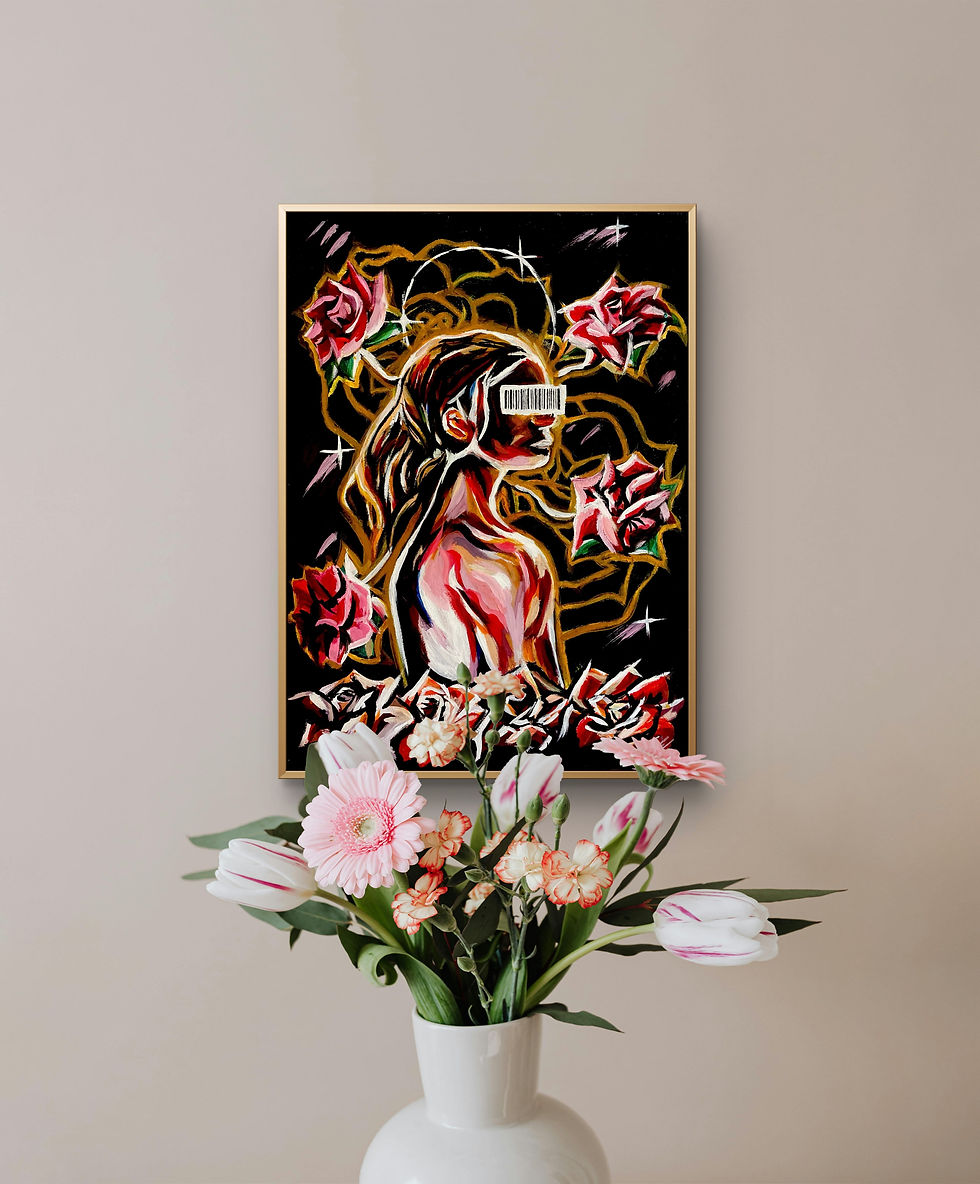
Like most artists, my art is filled with signature motifs that I use to both represent ideas and create striking visuals across my collections. My Painting, 'Hierarchies of Self ', is one of the strongest examples of the motifs that commonly occur in my work and can act as a guideline for artists on using unique and insightful motifs to elevate their work.

Where can “Motifs” Be Found?
The motifs in my work tend to originate from both cultural and historical sources that resonate with my personal taste as I learn about them. I’m influenced by artistic elements that connect me to stories from my people’s past, as well as by the modern media I encounter in my daily life. Black historical eras of fashion, the infusion of Japanese anime aesthetics, and the technical approaches found in other artists’ work all inform my process. I’m consistently drawn to imagery that feels visually striking—something I can carry forward and reinterpret in my next piece.
As my practice has grown, my taste has become clearer and inspiration easier to recognize. I often paint in earth tones and explore the hues beneath Black skin, fusing ethereal illumination with old-school Black fashion, Harlem Renaissance visual culture, and key elements from my earlier work. The longer I’ve created, the more I’ve seen my work move toward a distinct style and aesthetic—one I didn’t have the language for at first, but now understand as rooted in Black Dandyism. Artists often have to train this ability: to notice compelling visuals in the world around them, gradually shaping a unique aesthetic and developing a visual language they can call their own. Motifs become the building blocks of that essential process.
The individual visual elements that repeatedly occur within an artist’s body of work form the foundation of their style. Most of my ideas, like those of many artists, are influenced by the art I consume. I notice small but meaningful details that resonate with me and reimagine them through my own lens. Over time, these accumulated influences—past and present—passively shape what I create. My role as the artist is to translate them into visual form and communicate the emotions and histories they carry.


What is Black Dandyism?
Most recently highlighted at the 2025 Met Gala, the origins of the Black dandy are often traced back to the colonial era, when African and diasporic men used fashion to assert their humanity, identity, and pride in resistance to European imperialism. Hierarchies of Self marks the first moment in my artwork when I began consciously exploring elements of Black Dandyism and its visual and cultural significance.
Black Dandyism is often defined as a cultural movement that gained visibility in the late 19th and early 20th centuries, as Black Americans used style and presentation to push back against racial segregation and limiting social narratives. By merging their cultural sensibilities with established European standards of tailoring, they asserted autonomy and self-definition through dress. Over time, the movement expanded beyond formal suiting, influencing luxury fashion, streetwear, and broader cultural signifiers. Traditional tailoring became a foundation for a visual language that communicates authenticity, individuality, and confidence.
The adoption of European tailored suits gave African Americans a structured framework through which they could infuse personal style, cultural references, and expressive flair. While the garments followed established rules of dress, the way they were worn—through color, proportion, posture, and attitude—transformed them. Elements became more pronounced and stylized as Black Americans used fashion to declare their humanity with a presence and “swagger” that could not be ignored. The style evolved beyond imitation of high fashion; it became a subversion of exclusionary norms and a visible proclamation that Black identity could not be confined or diminished.
Wearing tailored European styles directly challenged prevailing ideas of Black inferiority at the time, functioning as both protest and affirmation—a visual statement that insisted, “we are human.” Over the decades, Black artists across disciplines—poets, jazz musicians, visual artists, and intellectuals—embraced deliberate, expressive dress to signal not only status, but creative authority and self-possession. This use of personal style as a form of resistance and self-definition deeply inspires me and continues to shape the conceptual direction of my work.

The Zoot Suit Era
It's only right that an entire section of my article be dedicated to one of the most influential suits in not only black dandyism, but all of black history: The Zoot Suit.
By the Harlem Renaissance of the 1920s, Black Dandyism had evolved into a sophisticated combination of identity, politics and Black Pride. The style of sharp dress, 3 piece suits, polished shoes, and silk ties elegance with defiance in a way that empowers black artists to embrace their creative potential. The Zoot Suit became more than an aesthetic, it transformed into a signal of identity and personal empowerment. In a time that saw black men struggling to see themselves as full people, given their label of second class citizenship, the Zoot suit made them feel reinvigorated, bolder, and more like the unobtainable masculine version of themselves they wanted the world to see them as.
The Zoot Suit embodies a bold declaration of identity with its broad oversized jacket, long chains, and bright patterns that made the presence of the wearer undeniable. The style took existing elements of traditional male fashion and amplified them as a means of compensating for the lack of dignity and respect given to the black man of the time. This style is made to gather attention and state the undeniable flair that came with the evolving black identity of the time. The zoot suit was embraced by marginalized youth including Black, Latino, and Filipino young men of the time.
Young men at the time adopted a new sense of self confidence built on the flashy style of the time which demanded attention no matter the setting. The Zoot Suit puts the spirit of Black Dandyism on full display: "we refuse to shrink and conform".

The Evolution of Black Dandyism
Over the course of its development, particularly by the 1920s, Black Dandyism remained an autonomous movement used by African Americans to control how they were perceived in the public eye. As Black Americans migrated north to escape the oppressive, violent, and impoverished conditions of the Jim Crow South, northern cities became spaces where self-presentation held new social and cultural meaning. Harlem became one of the most significant centers for Black art, poetry, music, and creativity to flourish. This period of cultural production became known as the Harlem Renaissance, widely regarded as one of the most prolific and defining eras for modern Black American cultural identity.
Notable Black artists, intellectuals, and creatives adopted the style in different ways over time, with each iteration shifting the direction of Black fashion and representation. W.E.B. Du Bois spoke about the adoption of refined dress and presentation as an important signifier of dignity and identity, helping spark broader conversations around self-representation and what would later be understood as respectability politics.
Artists continued to reinterpret this visual language across the decades. Barkley L. Hendricks—a personal inspiration—painted sharply dressed Black subjects from the 1960s through the 1980s, asserting that style and identity could function as sources of confidence, presence, and power. Ike Ude incorporated dandyism into his practice to display fashion that challenged gender norms and positioned clothing as a deliberate statement rather than simple decoration.
In the 1980s, Dapper Dan emerged as a key innovator and popularizer of the style, remixing European luxury logos into personalized streetwear and creating entirely new pathways for Black fashion. His work merged Harlem street style with the logomania of the 1980s and 1990s, expanding the definition of Black Dandyism and pushing it into a more contemporary, urban context.
With other influential figures such as James Baldwin and Duke Ellington contributing their own interpretations to the cultural lexicon of the style, dignity and identity remained at the core of its message. Across each era, Black Dandyism continued to function not just as a fashion aesthetic, but as a way to assert presence, humanity, and self-definition on one’s own terms.

What is Modern Black Dandyism? - The 2025 Met Gala And Beyond
Modern Black Dandyism incorporates African, Caribbean, and African American street-style influences into traditional tailoring, blending luxury with personal and cultural expression. It moves fluidly between formal and informal spaces—borrowing from heritage suiting, diasporic dress traditions, and contemporary fashion—while preserving a focus on precision, symbolism, and individuality. This evolution reflects a lineage that stretches from 18th- and 19th-century Black men who used dress to negotiate status and humanity, to the Harlem Renaissance, to the Congolese Sapeur movement, and into today’s global fashion culture.
In the present day, Black Dandyism continues to function as a visible proclamation of identity while honoring the historical conditions that shaped its core values. Black identity today still centers autonomy, authenticity, and confidence, often in resistance to commercialization and cultural appropriation. The style therefore operates as more than an aesthetic choice; it is a deliberate act of self-definition. Through tailoring, posture, and presentation, Black Dandyism asserts presence, humanity, and dignity in spaces where Black expression has historically been regulated, commodified, or misunderstood. It communicates care, discipline, and self-possession—qualities that challenge stereotypes and reposition the wearer as both subject and author of their own narrative.
Historically, dandyism among Black communities was never simply imitation of European fashion. Instead, it became a strategy: a way to reclaim visibility, signal intellect and refinement, and resist imposed identities. Over time, the style absorbed influences from migration, music, political movements, and everyday street culture. This adaptability is what allows it to remain contemporary while still carrying its historical weight.
In 2025, tailored suiting, heritage references, and personal reinterpretations dominated the night as the theme “Superfine: Tailoring Black Style” encouraged artists such as Pharrell Williams, Doechii, and A$AP Rocky to express freedom through refined, highly individualized ensembles. The event highlighted how contemporary Black fashion continues to merge elegance with cultural storytelling. Audiences gravitated toward looks that balanced historical reference with experimentation—from the polka-dot ascot on Rihanna’s tailored suit gown to Imaan Hammam’s exaggerated zoot-suit proportions and cane. These moments demonstrated how Black Dandyism thrives through reinterpretation: honoring past silhouettes while reshaping them for modern visibility, performance, and self-expression.
Together, these contemporary expressions show that Black Dandyism is not static. It is a living cultural language—one that continually absorbs new influences while reaffirming its foundational commitment to dignity, creativity, and the right to define oneself.
![[Top Left to Right]](https://static.wixstatic.com/media/253a61_5361cbd8b23c452c86378aaba8bc4fed~mv2.jpeg/v1/fill/w_980,h_653,al_c,q_85,usm_0.66_1.00_0.01,enc_avif,quality_auto/253a61_5361cbd8b23c452c86378aaba8bc4fed~mv2.jpeg)
Bobo Doll, 2025.
Gold Roses 2, 2025.
Hierarchies of Self, 2025.
Legacy In Blue, 2025.
How does this influence my practice?
The mindset and historical context that shaped Black Dandyism inspire me to incorporate it into my work on a thematic level. While the aesthetic is visually compelling and deeply satisfying to capture in art, it is important to acknowledge the earlier cultural and social conditions that produced the style as we know it today. Black Dandyism emerged not simply as fashion, but as a deliberate expression of autonomy, dignity, and resistance within societies that often denied Black individuality.
Black Dandyism aligns with my personal practice’s focus on identity and undeniable presence. The tailored suits create recognizable silhouettes that emphasize the individual’s form, making the body appear almost statue-like and monumental. I carry these qualities into my own work by using imposing silhouettes and eyeless faces to create a sense of power, permanence, and self-possession in my subjects.
The rich earth tones often associated with Black Dandyism evoke a calm yet intense presence. My work operates within a similar palette: bright oranges and yellows act as highlights, while browns and neutral hues provide contrast and grounding. These tones allow the brighter colors to illuminate the canvas while maintaining a sense of depth and stability.
Black Dandyism also communicates a confidence that feels earned and dignified. It presents identity on the subject’s own terms, rather than positioning them as an object of scrutiny. The pursuit and assertion of identity has long been central to Black history, and this idea connects directly to my personal practice as a Black artist.
As my appreciation for this lifestyle, mentality, and aesthetic continues to grow, so does my inspiration to create. My art aims to evoke that same feeling of inner intensity held within a calm, controlled atmosphere—presence without spectacle, strength without aggression.

Who Am I?
My name is Ethan Johnson
I'm an Atlanta based acrylic artist
I hope you enjoyed my article and learned something about art and my practice.
My work hopes to inspire other artists to embrace their authentic vision and push the way we view painting forward through embracing all voices.
Subscribing to the email list is the best way to keep up with 90% of new activity from me, but here are some of my other socials that I operate on.
Follow my TikTok - @notta_demigod
The Piece 'Hierarchies of Self' is SOLD
Fine Art Prints are AVAILABLE NOW


Comments